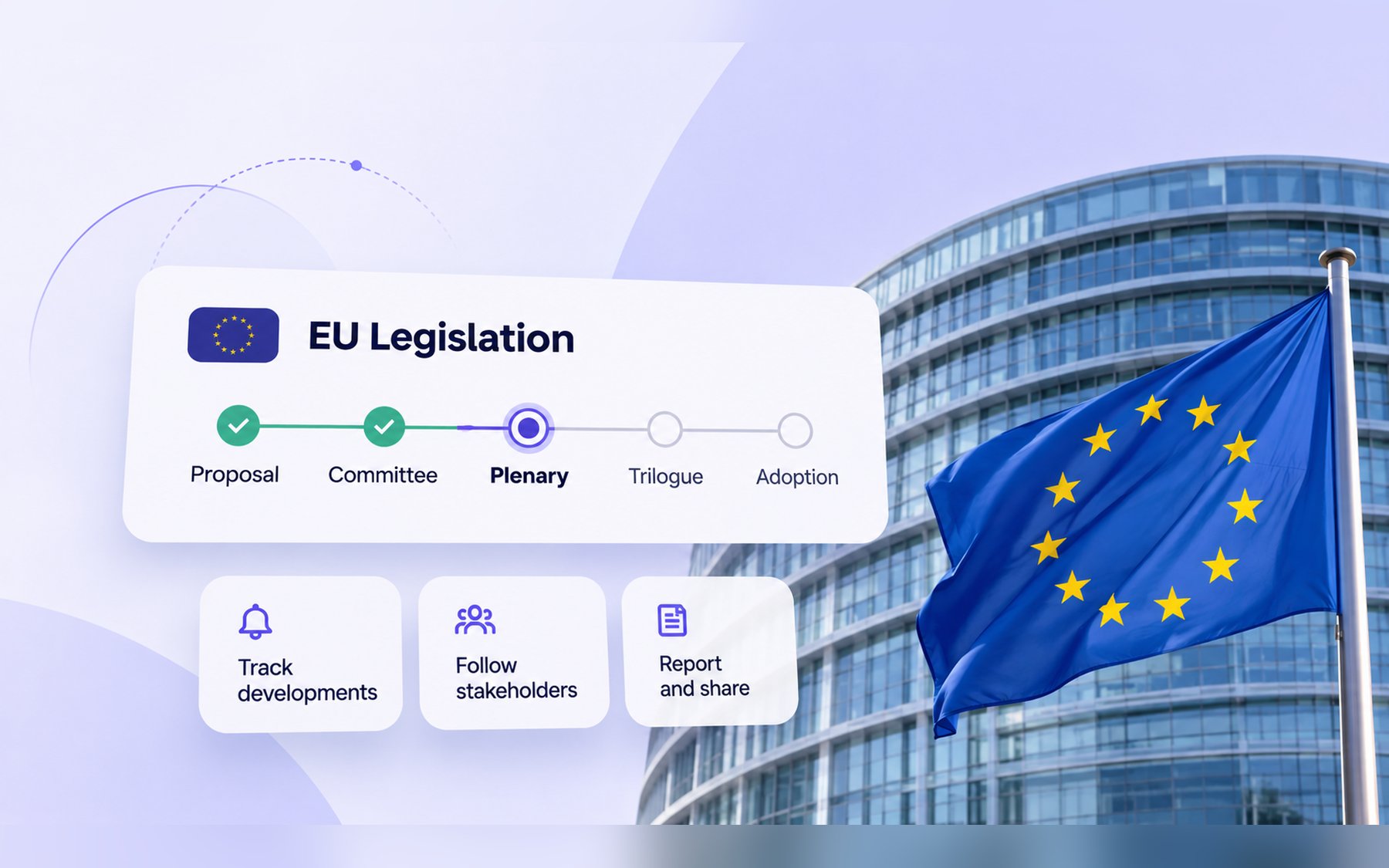
European Union legislation shapes how organisations operate, from environmental standards and digital regulation to consumer protection, trade and financial services. For public affairs professionals, regulatory teams and trade associations, keeping track of these developments is essential. Yet monitoring legislation across multiple EU institutions, policy areas and stages of the legislative process can quickly become time-consuming.
EU legislative tracking tools help organisations monitor legislative developments, identify relevant policy changes and turn regulatory information into actionable intelligence. They bring together information from EU institutions, automate parts of the monitoring process and help teams understand which developments require attention.
This guide explains how EU legislative tracking works, which sources and tools are available, how artificial intelligence is changing regulatory monitoring and what organisations should consider when choosing a legislative tracking solution.
What are EU legislative tracking tools?
EU legislative tracking tools are digital platforms and information services that help organisations follow legislative proposals, regulatory developments and institutional decisions across the European Union.
They allow public affairs, government relations and regulatory teams to monitor the progress of legislation, identify relevant developments and assess their potential implications.
Depending on the platform, EU legislation tracking tools may provide:
- Legislative monitoring: Tracking proposals, amendments and decisions throughout the EU legislative process.
- Regulatory alerts: Notifications about new documents, procedural developments and changes affecting selected policy areas.
- Policy intelligence: Information that helps organisations understand the context and potential implications of legislative developments.
- Stakeholder intelligence: Information about institutions, policymakers and other actors involved in shaping legislation.
- Collaboration tools: Shared workspaces for coordinating monitoring activities, responsibilities and responses.
- Automated reporting: Tools for producing internal briefings, policy updates and stakeholder reports.
Traditional legislative tracking focuses primarily on identifying and following developments. More comprehensive public affairs platforms connect this information with the workflows organisations use to analyse, communicate and respond to policy changes.
How can organisations track EU legislation?
Organisations can track EU legislation through official EU information sources, manual monitoring processes or specialised legislative monitoring software. The most effective approach depends on the number of policy areas being followed, the frequency of updates required and the organisation’s internal resources.
1. Monitor official EU legislative sources
The European Union provides several publicly accessible sources for following legislative developments.
EUR-Lex
EUR-Lex provides access to EU law, including treaties, regulations, directives, decisions, legislative proposals and other official documents. It is an essential source for researching EU legislation and accessing the Official Journal of the European Union.
European Commission
The European Commission publishes legislative initiatives, policy priorities, consultations and proposals. Its Have Your Say portal allows organisations to follow initiatives and participate in consultation processes.
European Parliament
The European Parliament’s Legislative Observatory provides information about legislative procedures, parliamentary committees, reports, amendments and institutional developments.
Council of the European Union
The Council of the European Union publishes information about Council meetings, legislative negotiations, policy positions and adopted measures.
These sources provide the foundation for EU legislative monitoring. However, they serve different purposes, meaning that organisations often need to consult several platforms to follow a single legislative file.
2. Establish a structured monitoring process
Access to legislative information is only one part of effective monitoring.
Organisations also need to determine which developments matter, who should review them and how information should be communicated internally.
A structured monitoring process typically involves identifying priority policy areas, following relevant legislative files, reviewing new developments, assessing their implications and distributing updates to the appropriate colleagues.
For teams monitoring several policy areas simultaneously, these activities can require considerable manual coordination.
3. Use dedicated legislative monitoring software
Specialised EU legislative tracking tools can help organisations manage these activities more efficiently.
Rather than checking multiple institutional websites individually, teams can use monitoring platforms to organise relevant information, follow legislative developments and coordinate their responses.
Some platforms also integrate stakeholder information, team collaboration and reporting, allowing organisations to connect legislative intelligence with their broader public affairs activities.
What is the difference between legislative monitoring and regulatory tracking?
Legislative monitoring and regulatory tracking are closely related activities, but they focus on different aspects of the policymaking and regulatory process.
Legislative monitoring focuses on the development, negotiation and adoption of legislation. It involves following proposals, amendments, parliamentary discussions, institutional positions and legislative decisions.
Regulatory tracking is a broader activity that may include monitoring legislation alongside delegated and implementing acts, regulatory guidance, supervisory developments and other requirements affecting an organisation.
Compliance monitoring focuses on identifying and understanding applicable obligations and assessing how changes may affect an organisation’s compliance responsibilities.
Regulatory intelligence goes beyond collecting information. It involves analysing regulatory developments, assessing their significance and communicating insights that support organisational decisions.
These activities frequently overlap.
For example, a public affairs team might monitor an upcoming EU regulation, assess proposed amendments, identify relevant policymakers and brief senior management about potential implications.
A compliance team may subsequently use information about the adopted regulation to prepare for implementation.
An effective monitoring system should support the information needs of these different teams without confusing legislative developments with legally binding compliance obligations.
What features should an EU legislative tracking tool have?
An effective EU legislative tracking tool should provide reliable access to legislative information, relevant alerts, clear tracking of legislative developments and capabilities that help teams organise and communicate their findings.
The most useful features depend on an organisation’s monitoring responsibilities and internal workflows.
Comprehensive legislative coverage
A monitoring platform should provide access to relevant developments across the EU institutions and policy areas an organisation follows.
This may include legislative proposals, parliamentary reports, amendments, committee activities, Council developments, consultations and adopted legislation.
Coverage should be assessed carefully, particularly when organisations monitor specialised policy areas or require information from multiple stages of the legislative process.
Customisable monitoring and alerts
Different organisations have different legislative priorities.
A trade association may follow developments affecting an entire industry, while a corporate public affairs team may monitor a smaller set of legislative files with direct commercial implications.
Customisable monitoring allows teams to organise information around relevant topics, keywords, institutions or legislative procedures.
Alerts help ensure that important developments are identified without requiring users to search for updates manually.
Stakeholder intelligence
Understanding legislation also means understanding the institutions and individuals involved in shaping it.
Stakeholder intelligence can help public affairs teams identify relevant policymakers, follow institutional responsibilities and organise information about their engagement activities.
Connecting stakeholder information with legislative files makes it easier to understand the political context surrounding a proposal.
Collaboration and knowledge management
Legislative monitoring rarely happens in isolation.
Public affairs professionals often need to share information with legal, compliance, communications and management teams.
Collaboration features allow organisations to coordinate responsibilities, share analysis and maintain a common understanding of relevant developments.
Knowledge management is equally important. Legislative files can remain active for years, and organisations benefit from preserving previous analysis, institutional knowledge and engagement history.
Reporting and communication
Monitoring information becomes more valuable when it can be communicated clearly.
Public affairs teams regularly prepare legislative updates, management briefings, policy summaries and stakeholder reports.
Reporting capabilities can reduce the time required to compile information and help ensure that different audiences receive relevant updates.
The objective is not simply to collect more information, but to make legislative intelligence easier to use across an organisation.
How is AI changing EU legislative monitoring?
Artificial intelligence is changing EU legislative monitoring by helping organisations process large volumes of policy information, summarise complex documents and identify relevant developments more efficiently.
EU institutions produce extensive documentation throughout the legislative process. Reviewing proposals, amendments, reports and supporting documents can require substantial time, particularly for teams following multiple legislative files.
AI-assisted monitoring can support several activities.
Summarising legislative documents
AI can help generate summaries of lengthy legislative proposals, policy documents and institutional publications.
These summaries allow professionals to identify the main issues before examining the original documents in greater detail.
For example, a public affairs professional following changes to EU digital regulation may use an AI-generated summary to understand the main provisions of a new proposal.
Identifying relevant developments
AI-assisted tools can help organise and classify legislative information according to policy areas, topics or organisational priorities.
This can make it easier to identify potentially relevant documents among large volumes of institutional information.
However, relevance depends on the quality of the underlying information and the criteria used to assess it.
Supporting legislative analysis
AI can assist professionals in examining legislative texts, identifying important provisions and preparing initial explanations of complex developments.
It can also support the preparation of internal briefings and policy summaries.
These capabilities are particularly useful when teams need to communicate technical legislative developments to colleagues without specialist knowledge of EU policymaking.
Reducing repetitive administrative work
A significant amount of public affairs work involves collecting information, organising updates and preparing recurring reports.
AI-assisted workflows can reduce some of this manual effort, allowing professionals to spend more time on analysis, stakeholder engagement and strategic decision-making.
Why human oversight remains essential
AI-generated legislative analysis should not replace verification against official sources or professional judgement.
Legislative proposals can change significantly during negotiations, and an inaccurate interpretation of a provision may lead to incorrect conclusions.
Organisations should therefore ensure that AI-assisted monitoring provides access to original documents and allows users to verify important information.
The greatest value of AI in legislative monitoring is not replacing public affairs expertise, but making it easier for professionals to apply that expertise.
How can organisations improve their EU legislative monitoring processes?
Organisations can improve legislative monitoring by establishing clear priorities, centralising relevant information, assigning responsibilities and creating consistent reporting workflows.
A useful monitoring process should connect the identification of legislative developments with their analysis and the decisions that follow.
Step 1: Identify legislative priorities
Start by defining which policy areas, legislative files and regulatory developments matter most to the organisation.
These priorities should reflect the organisation’s activities, strategic objectives and potential exposure to regulatory changes.
For example, a company operating in the energy sector may prioritise climate policy, energy market regulation and industrial legislation.
Step 2: Establish reliable information sources
Identify the official EU sources and monitoring services needed to follow those priorities.
Ensure that the monitoring process covers relevant institutions and stages of the legislative process.
Step 3: Organise information by topic or legislative file
A consistent structure makes information easier to find and manage.
Teams can organise monitoring activities around policy areas, legislative files, internal responsibilities or organisational priorities.
This also helps prevent important information from becoming scattered across individual inboxes, spreadsheets and documents.
Step 4: Assign responsibilities
Determine who is responsible for reviewing developments, assessing their significance and communicating updates.
Clear responsibilities help ensure that monitoring information leads to appropriate follow-up.
Step 5: Connect monitoring with stakeholder engagement
When a legislative development requires attention, public affairs teams may need to identify relevant institutions, policymakers or other stakeholders.
Connecting monitoring information with stakeholder intelligence supports a more coordinated response.
Step 6: Establish regular reporting
Different audiences need different levels of detail.
Senior management may require concise summaries of strategic implications, while policy specialists need detailed information about legislative developments.
A consistent reporting process helps ensure that information reaches the right people in a useful format.
Step 7: Review and improve the process
Monitoring priorities change as legislative files progress and new policy initiatives emerge.
Organisations should regularly review their monitoring activities, assess whether relevant developments are being identified and identify opportunities to reduce unnecessary manual work.
Effective legislative monitoring is a continuous process that connects information gathering, analysis, collaboration and decision-making.
How do you choose the right EU legislative tracking tool?
Choosing an EU legislative tracking tool requires evaluating both the quality of its legislative information and how well it supports an organisation’s existing workflows.
The right solution depends on the organisation’s size, policy priorities, monitoring requirements and internal processes.
Before selecting a platform, teams should consider the following questions.
1. Does the tool cover the legislation and institutions we need to monitor?
Assess whether the platform provides access to relevant EU legislative developments and supports the policy areas most important to your organisation.
2. Can we customise monitoring to our priorities?
Look for the ability to follow specific legislative files, topics and developments without receiving excessive irrelevant information.
3. How easily can we understand legislative developments?
Consider whether the platform helps users navigate complex documents, understand procedural developments and identify information requiring attention.
4. Does the platform support collaboration?
Evaluate whether colleagues can share information, coordinate responsibilities and maintain a common understanding of legislative developments.
5. Can we connect monitoring with stakeholder intelligence?
For public affairs teams, legislative information becomes more useful when it can be connected with relevant institutions, policymakers and engagement activities.
6. How does the platform support reporting?
Consider how easily users can prepare internal updates, management briefings and other recurring communications.
7. Can we verify information against original sources?
Reliable legislative monitoring requires access to authoritative information. Users should be able to check important developments and interpretations against official documents.
8. Will the platform reduce manual work?
A useful evaluation should examine the complete monitoring workflow, not simply the number of available features.
For example, organisations can test how long it takes to identify a relevant legislative development, understand its implications and communicate an update to colleagues.
The most suitable solution is one that fits the organisation’s actual working practices while improving the quality and efficiency of legislative monitoring.
From legislative tracking to public affairs intelligence
EU legislative monitoring has traditionally focused on following institutional developments and keeping organisations informed about regulatory change.
While these activities remain essential, public affairs teams increasingly need to connect monitoring with analysis, stakeholder engagement, internal collaboration and reporting.
This creates a distinction between simply tracking legislation and managing the broader public affairs workflow.
An integrated approach allows organisations to maintain a clearer overview of legislative priorities, preserve institutional knowledge and coordinate responses across teams.
SAVOIRR is designed around this approach.
The platform combines legislative monitoring with stakeholder intelligence, collaboration, knowledge management and reporting capabilities in a shared public affairs workspace.
Rather than treating legislative monitoring as an isolated activity, SAVOIRR helps teams connect policy developments with the people, information and processes involved in their work.
For organisations managing multiple legislative files and stakeholders, this approach can help reduce fragmented workflows and make regulatory intelligence more accessible across the team.
Frequently asked questions about EU legislative tracking
What is the best way to track EU legislation?
The best way to track EU legislation is to combine reliable official EU sources with a structured monitoring process. Organisations following multiple policy areas may benefit from dedicated legislative tracking software that provides relevant alerts, organises legislative information and supports collaboration.
Is EUR-Lex sufficient for EU legislative monitoring?
EUR-Lex is an authoritative source for EU legal documents and legislative information. However, organisations requiring continuous monitoring across institutions, customised alerts, stakeholder intelligence or collaborative reporting may need additional tools and processes.
What is the difference between EU legislative monitoring and regulatory intelligence?
EU legislative monitoring focuses on identifying and following legislative developments. Regulatory intelligence involves analysing those developments, assessing their implications and communicating insights that support organisational decisions.
Can AI monitor EU legislation?
AI can assist with EU legislative monitoring by summarising documents, organising information, identifying potentially relevant developments and supporting analysis. However, reliable monitoring also requires authoritative sources, appropriate coverage and human verification of important findings.
Who needs EU legislative tracking software?
EU legislative tracking software is used by public affairs professionals, government relations teams, trade associations, regulatory affairs specialists, consultancies and organisations affected by EU policymaking. It is particularly useful for teams monitoring multiple legislative files or policy areas.
How can public affairs teams reduce time spent monitoring legislation?
Public affairs teams can reduce manual monitoring work by centralising information, automating relevant alerts, organising legislative files consistently and using shared reporting workflows. AI-assisted summarisation and analysis can also help teams process information more efficiently.
What should organisations look for in EU legislative monitoring software?
Organisations should prioritise reliable legislative coverage, relevant alerts, clear information organisation, source verification and support for their existing workflows. Teams managing broader public affairs activities may also benefit from stakeholder intelligence, collaboration and reporting capabilities.
How does legislative monitoring support public affairs strategy?
Legislative monitoring helps public affairs teams identify emerging policy developments, understand institutional processes and determine when engagement or internal action may be necessary. Connecting monitoring with stakeholder intelligence and reporting allows organisations to respond more effectively to legislative developments.
Make EU legislative monitoring more effective
EU legislative monitoring is essential for organisations that need to understand and respond to European policymaking.
Official EU sources provide access to legislative information, while structured monitoring processes help organisations identify relevant developments and communicate their implications.
Modern legislative tracking platforms can bring these activities together, reducing fragmented workflows and supporting more coordinated public affairs work.
For teams managing complex legislative priorities, the objective is not simply to receive more updates. It is to turn legislative information into useful intelligence that supports better decisions.
Discover how SAVOIRR connects EU legislative monitoring, stakeholder intelligence and public affairs workflows in one platform.
[Book a SAVOIRR demo]